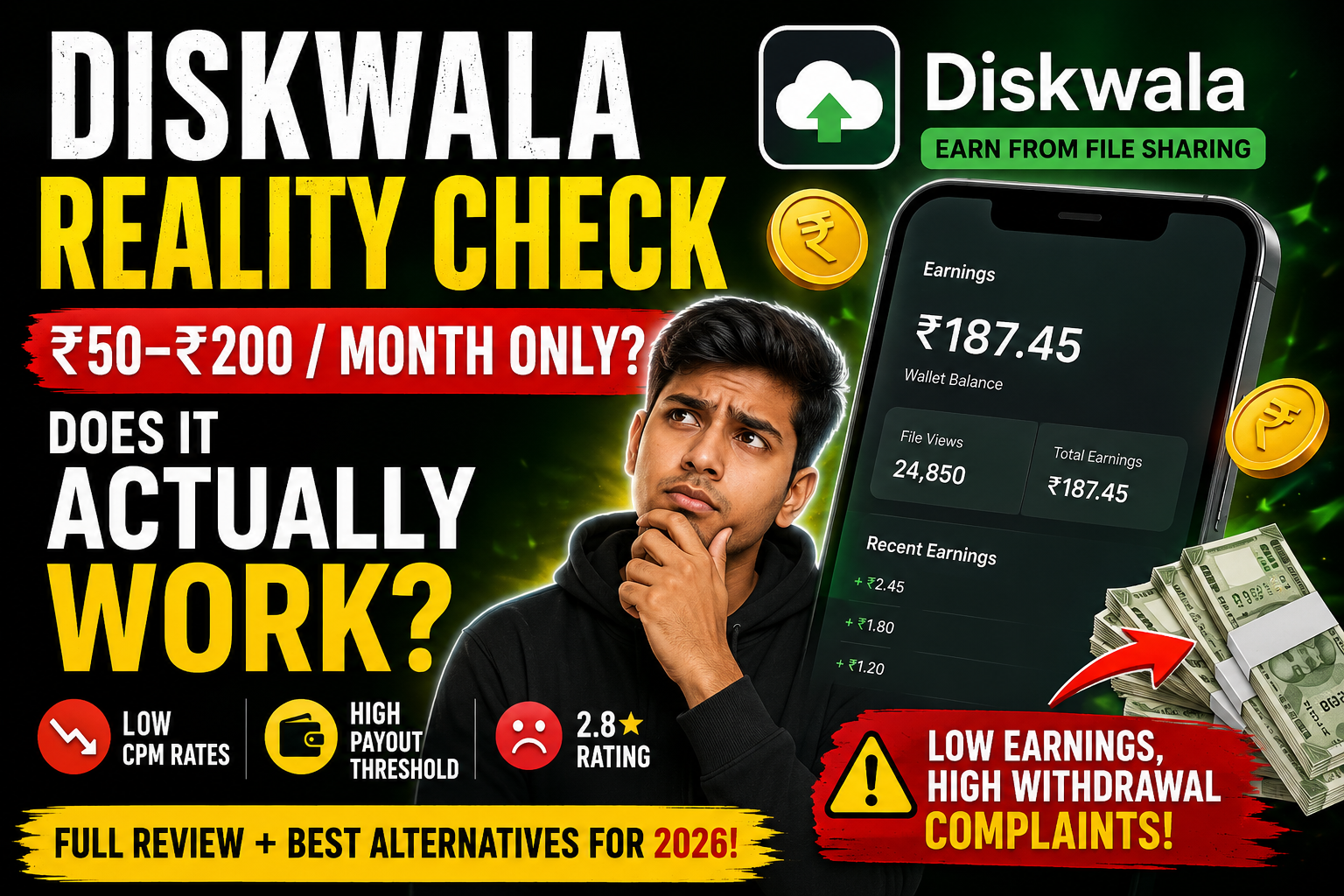
The advertisement is disarmingly simple: upload a video or file, share the link, and earn money every time someone clicks it. No investment. No skills required. No camera. No audience to build. Just files, links, and rupees flowing into your account. Diskwala — a platform operated by DISKWALA LLC and downloaded over ten million times on Google Play alone — has built a rapidly growing base of Indian users on exactly this promise. The question this article sets out to answer is direct: does it actually work?
After examining Diskwala's official documentation, cross-referencing independent user reviews, analysing its terms of service, and comparing its earning system against analogous platforms, the answer is nuanced but essentially cautionary for anyone treating it as a reliable income source. The earning system is technically real. But a combination of extremely low per-view rates, opaque payout thresholds, a 2.8-star rating driven largely by withdrawal complaints, and significant unanswered questions about the platform's long-term financial viability means that the gap between the promise and the practical reality is wide — and almost never acknowledged in Diskwala's own marketing materials.
This article covers two things: first, a forensic examination of every layer of the Diskwala earning system — how it claims to work, how it actually works, and where the friction points are; second, a comprehensive guide to legitimate alternatives for Indian creators and file-sharers who want to genuinely monetise their content in 2026. Whether you are a video creator, a document sharer, a student, or simply someone who heard about Diskwala from a friend, this guide will give you the full picture before you invest your time.
Diskwala's earning system is real but practically yields ₹50–₹200 per month for typical Indian users — far below the ₹500–₹2,000 figures commonly promoted online. Earnings are tied to ad revenue shares that fluctuate without warning, minimum withdrawal thresholds are high, and payout complaints dominate the user review section. For anyone serious about earning from content, YouTube (ad revenue), Instagram Reels (bonus program), or ShareChat's creator fund deliver demonstrably better and more transparent returns — even for audiences under 1,000 followers.
Part I: The Diskwala Earning System — A Forensic Breakdown
Let us begin with the headline mechanism. Diskwala allocates every registered user a cloud storage account and the ability to generate shareable links for any file — video, document, image, or archive. When a recipient clicks that link and the file loads inside Diskwala's own interface, an advertisement plays or displays. A portion of the advertising revenue generated by that view is credited to the sharer's account as "coins" or a direct cash equivalent. This is the foundational loop: share files, drive views, earn ad revenue.
The concept is not invented by Diskwala — it has precedents in services like AdFly and earlier link-shortening monetisation platforms. But the specific implementation, the earning rates, and the withdrawal mechanics determine whether the model genuinely benefits users or primarily benefits the platform. On each of these dimensions, Diskwala's record is troubling.
The Per-View Rate: The Number Nobody Publishes
The most consequential piece of information for any prospective Diskwala earner is the per-view rate: how much money does one view of a shared file actually generate? Diskwala does not publish this figure anywhere in its primary marketing materials, onboarding screens, or help documentation. The omission is not accidental; it is structural. A platform built around earning claims that declines to state its earning rate in advance is, by definition, asking users to trust a number they cannot verify until they are already invested.
Independent testing and aggregated user reports — drawn from Hindi and English YouTube reviews, Reddit threads, and the Google Play review section — converge on a range of approximately ₹1 to ₹5 per 1,000 views for Indian-origin traffic. International traffic from Tier-1 countries (US, UK, Canada, Australia) generates higher CPM rates, but Indian users sharing files primarily with Indian audiences will earn at the lower end of this range. By comparison, YouTube pays Indian creators approximately ₹30–₹80 per 1,000 views on monetised content — twenty to forty times more, on a platform with a vastly larger discovery engine.
The Minimum Withdrawal Threshold: The Silent Trap
Diskwala sets a minimum balance requirement before earnings can be withdrawn. Based on user reports across Google Play reviews and independent blog analyses, this threshold sits in the range of ₹200 to ₹500 depending on withdrawal method — the figure has also been reported to shift without prior notice to users. For a user earning ₹2 per month at typical view rates, reaching the withdrawal threshold would require between 100 and 250 months of uninterrupted use. This is not a withdrawal system; it is, in practice, a holding mechanism for the vast majority of users.
The withdrawal threshold problem is compounded by the platform's coin conversion system. Diskwala credits users in "coins" or an internal currency equivalent, which must then be converted to rupees at a rate controlled by the platform. This rate, like the per-view CPM, is not published in advance and has been reported to change without notification. Users who believe they have accumulated a meaningful coin balance may find, upon conversion, that the rupee equivalent is substantially lower than anticipated.
The Account Suspension Risk: Earning That Disappears
Among the most frequently cited complaints in Diskwala's Google Play review section — which aggregates 37,700 reviews at a 2.8-star average as of mid-2026 — is account suspension immediately before or during withdrawal requests. Multiple independent reviewers report a consistent pattern: accumulate earnings over weeks or months, attempt to withdraw, and receive an account suspension notice citing "terms of service violations" without specific explanation. The earnings are forfeited upon suspension.
This pattern — which has also been documented on file-sharing monetisation platforms globally — may reflect genuine misuse detection, aggressive fraud prevention, or a structural incentive for the platform to avoid paying out small accumulated balances at scale. In Diskwala's case, the absence of a transparent appeals process, combined with the reported frequency of suspensions at the withdrawal stage, makes it impossible to determine which explanation is correct. What is certain is that a meaningful proportion of users who reach the withdrawal threshold do not successfully withdraw.
The Referral System: Multi-Level Structure
Beyond direct file-view earnings, Diskwala operates a referral programme through which users earn a commission on the earnings generated by anyone they invite to the platform. On the surface, this is a standard affiliate mechanism common to many app-based earning platforms. In practice, Diskwala's referral system has the structural characteristics of a multi-level earning scheme: referred users also generate earnings credits for the original referrer, and in some documented versions of the terms, referrals of referrals generate a diminishing commission chain.
This structure incentivises rapid user acquisition above sustained product quality. It also means that the most financially successful users on Diskwala are not necessarily those with the most valuable files or the largest genuine audiences — they are those who recruited the most sub-users. For anyone joining Diskwala today, the referral tiers above them are already densely populated, meaning the marginal referral earnings available to a new user are substantially lower than those available to early adopters.
Storage Reality: What "Unlimited" Actually Means
Diskwala promotes "unlimited storage" as a core feature. This claim requires examination. Like every platform offering unlimited storage without a revenue-generating subscription base sufficient to cover genuine infrastructure costs, Diskwala's unlimited storage is subject to the economics of its business model. The platform earns money through advertising displayed to file-viewers. If ad revenue does not cover storage costs — and for a platform with a 2.8-star rating suggesting high churn and limited engagement — storage infrastructure sustainability becomes a genuine question.
Independent technical observers have noted that Diskwala does not publish its infrastructure partners, server locations, or data retention policies with the specificity that credible cloud storage providers do. Users who depend on Diskwala as a primary file repository — as opposed to a link-sharing tool for viral content — may find their data at risk if the platform's financial sustainability deteriorates.
-
💸
Per-View Rate: Not Published, Rarely Discussed Earning rates of ₹1–₹5 per 1,000 views are derived from independent user reports, never from official Diskwala documentation. The platform promotes earnings without specifying the rate.
-
🔒
Withdrawal Threshold: High and Variable Minimum ₹200–₹500 required before any payout. Threshold has been reported to change without notice. Most users at typical view rates will never reach it.
-
🚫
Account Suspensions at Withdrawal Stage Hundreds of Google Play reviews document account suspension immediately upon initiating withdrawal. No transparent appeals process exists.
-
🔄
Coin-to-Rupee Conversion Rate: Controlled by Platform Internal currency creates an extra layer of opacity. Conversion rates are set and can be changed unilaterally by Diskwala without user consent.
-
📢
Heavy Advertising on Every File View Every person who clicks a Diskwala link is subjected to ads before accessing the content. This creates friction that reduces the likelihood of repeat clicks and damages user experience for anyone sharing files with a professional or client audience.
-
📉
Referral System Favours Early Adopters Multi-level referral structures disproportionately benefit users who joined early. New users in 2026 enter a saturated referral environment with meaningfully lower earning potential from invitations.
Part II: The Legitimacy and Safety Question
Earning potential aside, the question of whether Diskwala is a safe and legitimate platform to use deserves direct examination. The answer is layered: the platform is not a scam in the criminal sense — it does provide functional file sharing and it does credit user accounts with some earnings. But it exhibits several characteristics that, individually, would warrant caution, and collectively, paint a picture of a platform whose interests and its users' interests are not well aligned.
The Company: DISKWALA LLC
Diskwala is operated by DISKWALA LLC, registered in the United States. The company was founded in 2023 and, as of mid-2026, employs approximately one to five people according to corporate database records. The LLC structure provides legal legitimacy, but the tiny team size relative to the platform's claimed ten-million-plus user base raises immediate operational questions: who is handling customer support, dispute resolution, account appeals, and infrastructure maintenance for a platform at that scale?
The practical answer, observable in the review record, is that customer support is minimal to non-existent. The vast majority of Google Play and App Store reviews that report problems — suspended accounts, missing earnings, failed withdrawals — receive either no response or a boilerplate reply that does not address the specific complaint. For a platform whose core value proposition is financial — you give us your files and your audiences, we give you money — the absence of robust support infrastructure is not a minor product gap. It is a foundational trust problem.
"A platform that promises you money in exchange for your content and your audience, but cannot tell you the per-view rate, cannot commit to a withdrawal timeline, and suspends accounts at withdrawal without appeal — is a platform designed around the platform's interests, not the creator's."
Data Privacy: What Happens to Your Files
Diskwala's privacy policy, like that of most ad-supported file-sharing platforms, grants the company broad rights over user data for the purposes of operating and improving the service — which, in practice, includes the advertising that funds the earning system. Every file you upload, every link you share, and every user who clicks your links generates behavioural data that Diskwala's advertising partners can use for targeting. You are not merely sharing files; you are operating as a distribution node in an advertising network.
More concerning for file privacy: Diskwala does not offer end-to-end encryption or zero-knowledge storage. Every file you upload to Diskwala is, in principle, readable by the platform — which is a prerequisite for serving the ads that generate the earnings the platform promises. This is not unusual for ad-supported platforms, but users who assume cloud storage implies privacy need to understand that Diskwala's model is structurally incompatible with meaningful file privacy.
The 2.8-Star Rating: What the Reviews Actually Say
Diskwala's 2.8-star Google Play rating across 37,700 reviews is among the lowest of any platform in the file-sharing and cloud storage category with comparable download numbers. To understand what drives this rating, it is necessary to look at the content of the reviews — not just the average. The negative reviews cluster into four recurring themes: failed or delayed withdrawals, account suspensions without explanation, earnings that disappear after app updates, and customer support that does not respond. The positive reviews, by contrast, tend to be brief, generic ("good app, earning is there"), and in several cases follow a pattern consistent with incentivised reviewing — the same linguistic patterns, unusually rapid posting, and absence of specific detail that characterises reviews solicited in exchange for bonus earnings.
Part III: The Alternatives — A Complete 2026 Guide for Indian Creators
The underlying ambition behind Diskwala — earning money by sharing content you have already created — is entirely valid. The problem is not the concept; it is the specific platform. The alternatives below offer the same underlying opportunity — reaching audiences with content and generating income from that reach — but with transparently higher rates, vastly larger distribution engines, better creator protections, and in most cases a demonstrably more sustainable long-term income trajectory.
Category 1: Video Content Platforms
YouTube — The Only Sustainable Long-Term Choice
YouTube remains the most financially sustainable platform for Indian video creators at every level of scale. The YouTube Partner Programme — which becomes available at 1,000 subscribers and 4,000 hours of watch time, thresholds achievable within three to six months for consistent creators in popular niches — pays Indian creators approximately ₹30 to ₹80 per thousand views through its ad revenue share. On a channel generating 100,000 monthly views, this translates to ₹3,000 to ₹8,000 per month from ad revenue alone, before considering sponsorships, channel memberships, Super Chats, or merchandise.
The qualitative difference between YouTube and Diskwala is not just in the earning rate — it is in the structural position of the creator. On YouTube, your content lives in a searchable, algorithmically recommended ecosystem with 2.5 billion monthly users. A video you upload today can generate views and income years from now, compounding over time. On Diskwala, a shared file link generates ad revenue only when someone actively clicks it, meaning earnings require continuous manual promotion with no compounding discovery mechanism. YouTube builds assets; Diskwala generates one-time transactions.
Instagram Reels — The Fastest Path for Short-Form
Instagram's Reels Bonus Programme, available in India through select creator invitations, pays Indian creators a fixed monthly bonus based on Reels views — with payouts ranging from a few thousand to several lakh rupees per month for creators with large engaged audiences. Even outside the formal bonus programme, Instagram's reach mechanics mean that a single well-crafted Reel can generate hundreds of thousands of organic views without any paid promotion, giving creators a distribution engine that Diskwala's file-link model structurally cannot replicate.
Beyond platform payments, Instagram's creator positioning enables sponsorships that dwarf any platform-native earning rate. An Indian lifestyle creator with 50,000 followers can charge ₹5,000 to ₹25,000 per sponsored post — an amount that would require generating 1 to 25 million Diskwala file views to match.
MX TakaTak / Josh / Moj — The Indian Short-Form Ecosystem
India's domestic short-form video platforms — Josh (owned by ShareChat and backed by Google), Moj, and MX TakaTak — collectively host creator monetisation programmes specifically designed for Hindi and regional-language content creators. These platforms have the significant advantage of operating within Indian legal frameworks, paying in rupees through Indian payment infrastructure (UPI, bank transfer), and providing dedicated creator support teams. Josh's Creator Fund, for instance, pays verified creators monthly bonuses based on views and engagement with transparent eligibility criteria — a structural improvement over Diskwala's opaque earning system at every point of comparison.
Category 2: Direct Monetisation — Sell Your Files, Don't Share Them for Pennies
Gumroad — Sell Digital Files Globally
If the content you are sharing on Diskwala has genuine value — a tutorial document, a Photoshop template, a music track, a course PDF, a preset pack — the correct monetisation strategy is not to share it for free in exchange for a ₹2 advertising revenue share. It is to sell it directly. Gumroad, a global digital product marketplace, allows creators to sell digital files at any price they choose, with Gumroad retaining a 10% platform fee and the creator receiving the remainder via PayPal or Stripe.
A creator selling a ₹199 Lightroom preset pack needs only one sale to earn more than a Diskwala user generating 50,000 file views. The calculation reframes the entire premise: rather than asking how many people will click your Diskwala link, the more productive question is what value your content genuinely provides and whether that value warrants a price.
Instamojo — The Indian-First Direct Sales Option
Instamojo is India's most established digital product sales platform, built for Indian creators with Indian payment infrastructure from the ground up. It accepts UPI, NetBanking, debit and credit cards, and settles in rupees directly to Indian bank accounts — without the international payment complications of Gumroad or PayPal. Sellers can create a digital storefront, set any price for their files, and collect payment immediately.
Instamojo charges a 5% platform fee plus payment gateway charges, making it economically superior to Diskwala's ad-share model for any file with real value. A creator selling ten ₹99 study notes per month earns approximately ₹940 — a figure that would require 188,000 to 940,000 Diskwala file views to match at representative earning rates.
Telegram Paid Channels — The Underutilised Indian Model
Telegram's paid subscription feature allows creators to charge a monthly fee for access to a private channel — the same channel where they would otherwise share files for free on Diskwala. A creator with 500 subscribers paying ₹49 per month earns ₹24,500 monthly, with Telegram retaining a platform fee of approximately 15–30% depending on the subscription tier. This model is already widely used by Indian educators, stock market analysts, fitness trainers, and content creators — and requires no platform approval, no subscriber threshold, and no performance metrics to begin.
Category 3: Cloud Storage Alternatives — If You Just Need File Sharing
For users who came to Diskwala primarily for free cloud storage and file sharing — rather than the earning system — the alternatives are considerably stronger on every technical dimension.
Google Drive — The Undisputed Default
Google Drive provides 15 GB of free storage with zero throttling, permanent share links with granular permission controls, and the full Google Workspace integration. Shared files open instantly in the browser. No advertisement plays when a recipient opens a link. No account is required to view a shared file. For professional sharing — sending documents to clients, sharing presentations with colleagues, distributing files to students — Google Drive's friction-free recipient experience is categorically superior to Diskwala's ad-gated link structure.
JioAICloud — The Best Free Storage for Indian Users
Launched by Reliance Jio in 2024–2025, JioAICloud offers 100 GB of free storage to Jio subscribers, with servers physically located in Gujarat. Upload and download speeds on Indian connections regularly outperform international services due to local infrastructure proximity. JioAICloud is fully compliant with India's Digital Personal Data Protection (DPDP) Act, with data residency firmly within Indian jurisdiction. For Jio users who want to share files without attaching an advertising layer that frustrates their recipients, JioAICloud is the obvious and far superior choice.
WeTransfer Free — For One-Time Large File Sends
WeTransfer's free tier allows sending files up to 2 GB per transfer, with links that remain active for seven days. No account is required for the sender. Recipients click a clean, ad-minimal interface and download their file directly. For users who want to send a large file once — a video to a client, a portfolio to a recruiter, a project archive to a collaborator — WeTransfer's experience is faster, cleaner, and more professional than Diskwala's ad-gated equivalent. The trade-off is that there is no earning mechanism; but if you have established that Diskwala's earning mechanism yields less than ₹0.005 per transfer, that trade-off is readily worth making.
Part IV: The Master Comparison Table
Every platform examined in this review, compared across the dimensions that matter most for Indian creators and file-sharers.
| Platform | Earnings/1K Views | Payout Reliability | Free Storage | Discovery Engine | Best For |
|---|---|---|---|---|---|
| Diskwala | ₹1–₹5 | Poor (2.8★) | Unlimited (claimed) | ❌ None | Passive experiment only |
| YouTube | ₹30–₹80 | Excellent | Unlimited video | ✅ 2.5B users | Video creators |
| Instagram Reels | ₹15–₹60 | Good | Unlimited (media) | ✅ Explore feed | Short-form creators |
| ShareChat / Moj | ₹10–₹40 | Good | Unlimited (media) | ✅ India-focused | Hindi / Regional creators |
| Gumroad | Per sale (90%) | Excellent | Product hosting | ⚡ Marketplace | Digital product sellers |
| Instamojo | Per sale (95%) | Excellent | Product hosting | ⚡ India-native | Indian sellers |
| Google Drive | No earning system | — | 15 GB free | ✅ Fastest | Professional file sharing |
| JioAICloud | No earning system | — | 100 GB free | ✅ India speeds | Jio users in India |
| Telegram Paid | Per subscriber | Very Good | Unlimited messages | ⚡ Existing audience | Creators with Telegram base |
| WeTransfer Free | No earning system | — | 2 GB per transfer | ❌ None | One-time large sends |
Part V: Recommendations by Use Case
The right platform depends entirely on what you are actually trying to achieve. Here are direct, unambiguous recommendations.
Nothing in the creator economy comes close to YouTube for long-term value. The algorithm compounds over years, earnings are fully transparent, and the Partner Programme is among the most credible creator payment systems in the world. 1,000 subscribers to unlock monetisation — achievable within months for consistent creators.
- ✓ Transparent earnings
- ✓ Compounding discovery
- ✓ Proven global payouts
- ✕ Threshold to unlock
- ✕ Competitive market
If your files — notes, templates, presets, music, courses — have real value, charge for them directly. One ₹199 sale on Instamojo equals what 40,000–200,000 Diskwala views would earn. The economics are not comparable. UPI and bank transfer payouts, Indian support team, zero international complications.
- ✓ UPI / bank transfer
- ✓ Keep 95% of revenue
- ✓ No threshold to cash out
- ✕ Needs paying audience
- ✕ Marketing required
For creators whose content is in Hindi, Tamil, Telugu, Marathi, or other Indian languages, ShareChat and Moj offer the best discovery engine within India. Both platforms have active creator funds with transparent, regularly updated eligibility criteria and reliable monthly payments.
- ✓ Hindi/Regional first
- ✓ Creator fund active
- ✓ Indian infrastructure
- ✕ Lower global reach
- ✕ Smaller than YouTube
For sending files to clients, collaborators, and employers — where the recipient experience matters — Google Drive is the correct choice. No ads on shared links. Permanent links. Instant loading. No account required to view. The gap between Google Drive and Diskwala for professional use is not small; it is categorical.
- ✓ No ads for recipients
- ✓ Permanent links
- ✓ Fastest upload speed
- ✕ Only 15 GB free
- ✕ No earning system
If you need large free cloud storage to back up photos, videos, and documents — and you are a Jio subscriber — JioAICloud's 100 GB free tier on local Indian servers is the best storage deal in the market. No earning gimmick; just reliable, fast, locally compliant storage.
- ✓ 100 GB free
- ✓ Indian servers
- ✓ DPDP compliant
- ✕ Jio subscribers only
- ✕ No earning system
If you already share files regularly with a Telegram audience of any size, Telegram's paid subscription feature is a direct, high-leverage upgrade. Charge ₹49–₹199/month. Even 100 subscribers generates ₹4,900–₹19,900 monthly — an amount requiring 1–20 million Diskwala views to replicate.
- ✓ Direct subscriber revenue
- ✓ UPI payouts available
- ✓ No earnings threshold
- ✕ Needs existing audience
- ✕ Platform fee applies
Part VI: Is Diskwala Premium Worth Paying For?
Diskwala offers in-app purchases for premium features — unlocking higher earning multipliers, priority link access, and enhanced storage capabilities. The reported price range is approximately ₹99 to ₹499 per month depending on tier. The case for purchasing premium is, frankly, very difficult to make on the available evidence.
Premium earning multipliers amplify a base rate of ₹1–₹5 per 1,000 views. A 2× multiplier on ₹3 per 1,000 views produces ₹6 per 1,000 views — still a rate at which generating meaningful income requires an audience scale that, if you possess it, would generate orders-of-magnitude more income deployed on YouTube, Instagram, or a paid Telegram channel. Paying Diskwala for a premium tier to earn more from a system with fundamentally inadequate base rates is, structurally, not a rational economic decision.
Conclusion
Diskwala is not a fraud in the criminal sense. The platform functions. Files upload and share. The earning system credits accounts. Some users do withdraw some earnings. But the gap between what Diskwala implies in its marketing and what the average Indian creator actually experiences is wide enough to constitute, at minimum, a serious misleading of user expectations — and that matters when the currency being traded is not money but time.
Time spent building a Diskwala file library and driving views to ad-gated links is time not spent building a YouTube channel, an Instagram presence, a Telegram subscriber base, or a digital product catalogue — any one of which would generate more income in three months than most Diskwala users will earn in three years. The opportunity cost is the real cost of Diskwala, and it is never mentioned in the marketing.
For Indian creators in 2026, the landscape of legitimate, transparent, well-paying platforms has never been more accessible. YouTube's Partner Programme is achievable. Instagram Reels is distributing bonus payments. ShareChat and Moj are funding Hindi and regional creators. Instamojo and Gumroad are ready for anyone with a digital product to sell. The tools exist. The question is only whether you choose to spend your effort where the returns are genuinely commensurate with the work — or on a platform that promises a rupee while delivering a paisa.
Sources & References
- Google Play Store — DiskWala Reviews & Ratings (37,700+ reviews) — play.google.com
- Apple App Store — Diskwala App Ratings & Reviews (1,100+ ratings) — apps.apple.com
- Diskwala Official Website — Stream. Share. Everywhere. — diskwala.app
- Techno Gold — What is Diskwala? How to Earn Money with Diskwala (2025) — technogold.in
- Humseka Blog — How to Make Money Online with Disk Wala — A Real Beginner's Guide — humseka.blogspot.com
- Diskwala Pages — Diskwala: Secure Cloud Storage, Easy Sharing, & Creator Monetization — diskwala.pages.dev
- The Company Check — DiskWala Company Profile — thecompanycheck.com
- AppGoblin — TeraBox Android Analytics (Comparative Benchmark) — appgoblin.info
- YouTube India Creator Academy — Monetisation Eligibility & Partner Programme — support.google.com
- Meta for Creators — Instagram Reels Bonus Programme India — facebook.com/creators
- ShareChat Blog — Moj Creator Fund: Eligibility and Payment Details — sharechat.com
- Instamojo — Sell Digital Products Online in India — instamojo.com
- Gumroad — Pricing & Platform Fees 2026 — gumroad.com
- Telegram — Paid Subscriptions for Channels — telegram.org
- JioAICloud — Official Product Page — jio.com
- OpsMatters — Is Terabox Safe in 2026? (Comparative Privacy Analysis) — opsmatters.com
- MeitY — Digital Personal Data Protection Act, 2023 — meity.gov.in
- WeTransfer — Free Plan Features — wetransfer.com
- Google — Google Drive Free Storage Overview — support.google.com
- PandaYoo — Baidu's cloud storage DuBox changed its name to TeraBox (Origin Research) — pandayoo.com